The following presentation is not within the approved Prescribing Information. Talk with your doctor about what this might mean for you.
Additional results of the MAIA trial showing complete responses over time with DARZALEX® + Rd vs Rd alone
Researchers explored additional ways of looking at the results of the primary MAIA study
The original primary clinical study of DARZALEX® + Rd vs Rd alone was called the MAIA study. After the planned evaluation of the MAIA study outcomes was completed, researchers explored additional ways of looking at these results.
Additional evaluations that are not planned are called post hoc analyses. These post hoc analyses offer a chance to better understand the study results. Post hoc analysis can provide insight, but since the clinical trial was not designed to evaluate these additional results, the true effects may vary in unknown ways. It is important to note that post hoc analyses may represent outcomes that can be due to chance and cannot be considered conclusive. Because post hoc analyses were not planned, they are not as rigorous as the main study evaluations for which the clinical trial was designed.
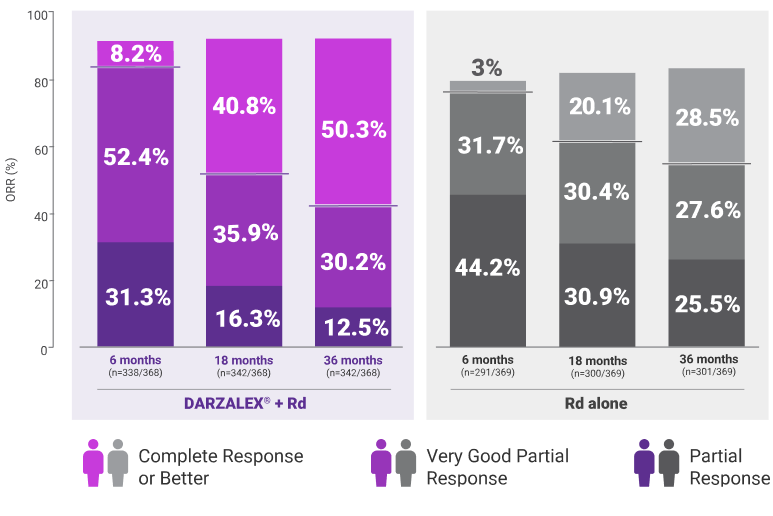
In this post hoc analysis, researchers looked at how people responded to DARZALEX® + Rd over time at 6, 18, and 36 months. This was done to explore long-term treatment responses with DARZALEX® + Rd vs Rd alone. The following demographic information was taken after 36 months.
Out of the original MAIA study group:
342 OF THE 368 PEOPLE
who received DARZALEX® + Rd achieved overall response rates (ORR) by 36 months and were included
301 OF THE 369 PEOPLE
who received Rd alone achieved overall response rates (ORR) by 36 months and were included
People who dropped out of the study for any specific reasons (eg, due to disease progression or achieving response at earlier times) were still included in this analysis.
The results you see may be numerically accurate. However, differences between treatments or the levels of the treatments’ effects may not be an accurate estimate of the expected effects in the study population.
Looking at responses over time
50%
of people achieved a complete response or better by 36 months of DARZALEX® + Rd
compared with ~8% by 6 months of treatment.
Each bar shows the treatment responses by specific time points (6, 18, and 36 months)
Response is used to measure how well multiple myeloma cells in your body are being controlled by therapy. As a response deepens (or gets better), fewer cancer cells remain. You can have a partial response, a very good partial response, or a complete response or better
The bars in the following charts show a “cumulative response,” meaning each bar shows the total number of best responses people achieved up to that time point
Treatment responses shown in these charts can change over time. The best response (complete response or better) can only become larger. The total of the response rates combined do not become lower
These results are not meant to display the total number of people who were in response at that specific time point
Each time point highlights the deepest treatment response (complete response or better) that a person reached up until that point
A person may reach a response better than a complete response, known as a stringent complete response, which is when there are no signs of cancer seen in imaging, blood, bone marrow tests, or in very sensitive serum and urine tests
More people on DARZALEX® + Rd reached deeper responses at each time point than people who received Rd alone
In this post hoc analysis, researchers looked at how people responded to DARZALEX® + Rd over time at 6, 18, and 36 months. This was done to explore long-term treatment responses with DARZALEX® + Rd vs Rd alone.
Treatment response with DARZALEX® + Rd vs Rd alone
50% of people achieved a complete response or better by 36 months of DARZALEX® + Rd treatment vs 28.5% in people who received Rd alone.
These results are factual, but since they were not based on the primary analysis plan, they have limitations. Also, they cannot reliably predict how patients who were not in the study may respond. Results may vary and you should discuss your specific circumstances with your doctor. No conclusions should be drawn.